

Revenue is what people see. Margin is what you keep. One of them pays you.
If you are asking what is a good real estate profit margin, here is the blunt answer. Plenty of teams and brokerages quietly run on thin margins, while Ken’s benchmark is a 40 percent profit margin on revenue. Anything far below that is a warning sign, not a rounding error.
For an established team leader or broker-owner, that margin matters far more than how big your GCI looks on a postcard. The common picture is a team doing $3M to $5M in GCI where everyone is busy, but the owner’s take-home and time freedom do not match the top line.
Ken’s stance is simple. The 40 percent target is not a nice-to-have. If revenue looks good but profit is thin, the business is broken, and you usually cannot feel it until a slow quarter exposes it.
This guide defines profit margin with real formulas and examples, compares typical margins for teams versus brokerages, explains why Ken pushes 40 percent, and gives you questions to stress-test your own numbers. If you want outside eyes, a Free Business Evaluation walks the same math with you.
What Is Profit Margin in a Real Estate Business? (Definition & Formula)
Profit margin is the percentage of your revenue you keep as profit after all expenses. The formula is profit divided by revenue, times 100. In real estate, revenue usually means GCI for a team, or company dollar after agent splits for a brokerage.
A couple of terms are worth pinning down. Revenue, GCI, and company dollar are not always the same thing: a brokerage’s real revenue is what is left after agent commissions are paid out. And while there is a technical difference between operating profit and net profit, for most teams and small firms they land close enough in practice that the question is the same one: what percent do you actually keep?
Put numbers on it and it gets clear fast. On $2M in revenue, $400K in profit is a 20 percent margin. On that same $2M, $800K in profit is a 40 percent margin, which is Ken’s benchmark. Same top line, double the result, because the model underneath is different.
What Is a Good Real Estate Profit Margin? (Ken’s 40% Target vs Industry Reality)
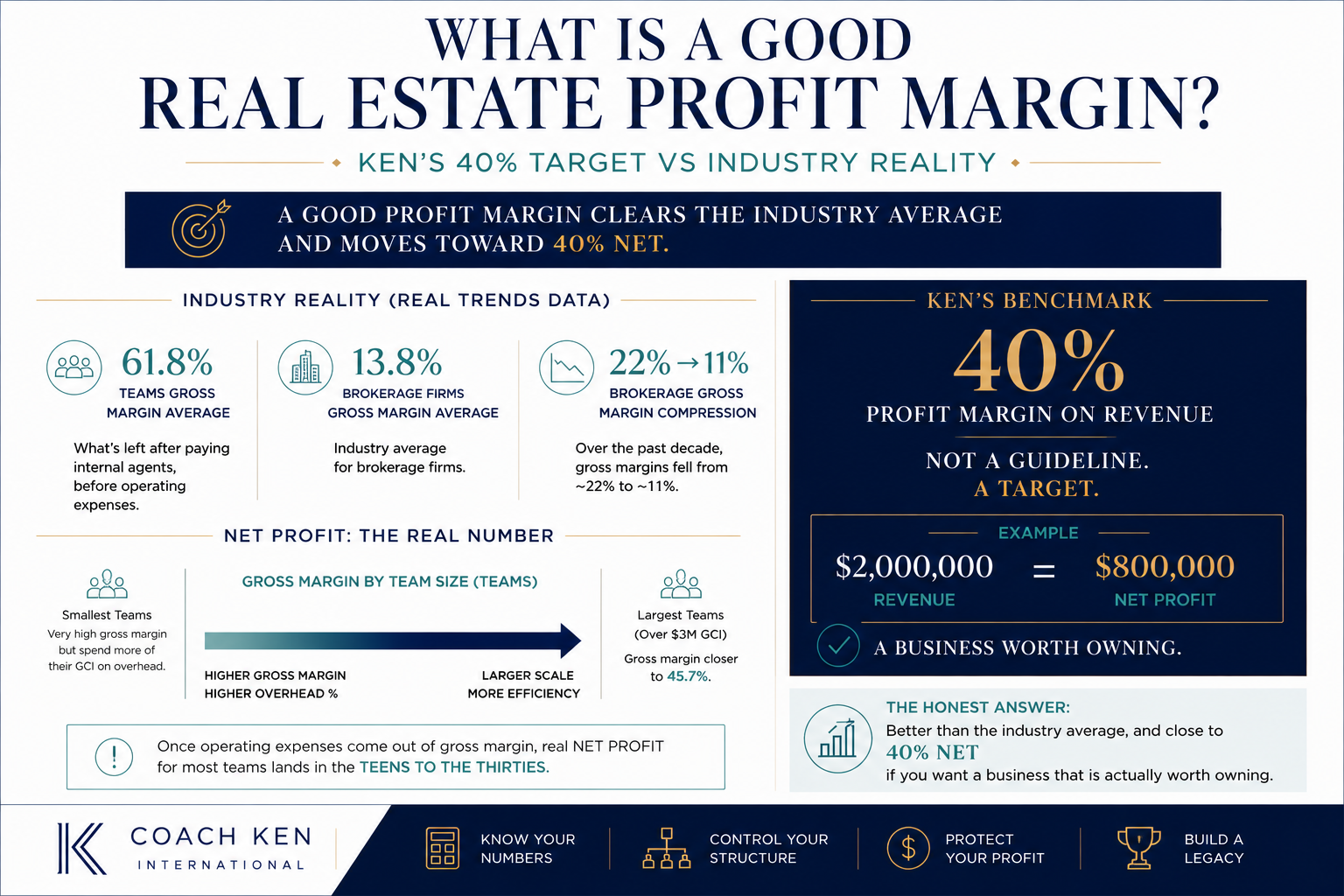
A good real estate profit margin is one that clears the industry average and moves toward 40 percent net. That is the bar for an operation worth owning, and most businesses sit well below it.
The industry data is sobering, and you have to read it carefully, because gross margin and net profit are not the same number. According to RealTrends benchmarking, real estate teams retained an average gross margin of about 61.8 percent, while brokerage firms averaged about 13.8 percent. That gross figure is what is left after paying internal agents, before operating expenses. Separately, RealTrends found brokerage gross margins have compressed over the past decade, from roughly 22 percent down to around 11 percent.
Net profit is what is left after operating expenses come out of that gross margin, and it is always lower. RealTrends team data shows the smallest teams keeping a very high gross margin but spending more of their GCI on overhead, while the largest teams, those over $3M in GCI, ran a gross margin closer to 45.7 percent. Once overhead is paid, real net profit for many teams lands somewhere in the teens to the thirties, depending on how lean they run.
That is the backdrop for Ken’s number. His benchmark is a 40 percent profit margin on revenue. Not a guideline. A target. A team doing $2M in revenue should be keeping $800K, not the $200K so many settle for. So when you ask what is a good real estate profit margin, the honest answer is: better than the industry average, and close to 40 percent net if you want a business that is actually worth owning.
How to Calculate Your Real Estate Profit Margin (Step-by-Step)
To calculate your margin you need two numbers: total revenue and total expenses. Subtract expenses from revenue to get profit, then divide profit by revenue and multiply by 100. Here is the order to do it in.
- Decide your revenue definition. For a team, use total GCI or company dollar after splits. For a brokerage, use company dollar after agent splits, not gross GCI.
- Gather every expense. Cost of sale first (agent splits and referral fees), then operating expenses (salaries, marketing, rent, technology).
- Calculate profit and margin. Profit equals revenue minus total expenses. Margin equals profit divided by revenue, times 100.
Here is a team example. On $5M in GCI, with $2.5M going to agents and referrals and $1M in operating expenses, you are left with $1.5M in profit. That is a 30 percent margin. Solid, but still short of the target.
Now Ken’s target, scaled down. On $2M in revenue with $1.2M in total expenses, you keep $800K. That is a 40 percent margin. During a Free Business Evaluation, Ken’s team runs exactly this calculation on your real numbers, so the margin is a fact, not a guess.
Profit Margin Benchmarks: Teams vs Brokerages (Side-by-Side View)
Teams and brokerages have very different margin profiles. Teams keep a much higher share of revenue as gross margin than brokerages do, but both can drift into low-profit territory fast if they chase volume without watching costs.
On the team side, RealTrends data puts average gross margins above 60 percent, with the largest teams still near 45 percent. The catch is overhead. Net margin varies widely once you pay for staff, marketing, and tech, and the biggest risk for a team is overhead creep and splits that are too generous to recruit.
On the brokerage side, the numbers are tighter. Brokerage gross margins now average in the low teens, around 11 to 14 percent, after paying out agents and teams. That leaves very little room. Net profit is slim, fixed costs are high, and many brokerages run close to breakeven. This is why broker-owners have to be ruthless about their model, especially if a sale or succession is on the horizon.
So from this view, what is a good real estate profit margin depends on your model. For a team, 40 percent net is achievable with discipline, and anything stuck under 25 to 30 percent at scale needs a hard look. For a brokerage, consistently clearing the low-teens gross trap and protecting real net profit is the game, and owners should still challenge every line.
Why Ken Uses a 40% Profit Margin Target (Not Just “More Revenue”)
Ken pushes a 40 percent target because that is the point where the business stops owning the leader and starts creating options. Better owner pay, room to hire leadership, and a firm that is actually sellable.
The logic for a team is practical. A 40 percent net margin leaves room for leadership salaries, strategic hires, and reinvestment while still paying the owner properly. It also builds a cushion. When the market shifts, rates jump, or inventory dries up, a healthy margin means you adjust instead of panicking and cutting the wrong things.
It matters even more for succession. A firm with strong, predictable margins is far more attractive and far more valuable in a sale or an internal transition than one running on fumes. A buyer is paying for profit and durability, not for volume.
And this is not a number Ken pulled from a spreadsheet. It comes from decades of working inside real teams and brokerages, watching which ones survived a downturn and which ones did not. The healthy ones protected margin. Every time.
Inputs That Actually Move Profit Margin (What to Fix First)
Profit margin is an outcome, not a lever. The levers you can actually pull are revenue per deal, cost of sale, operating efficiency, and your mix of high versus low-margin deals. Work them in order.
- Improve revenue quality. Higher average price, better commission protection, and more repeat and referral business raise the value of every transaction.
- Control cost of sale. Set splits and caps on the reality of your numbers, manage performance, and stop overpaying just to recruit a name.
- Tighten operating expenses. Right-size staff, audit the tech stack, and keep only the tools that clearly improve revenue or efficiency.
- Focus on high-margin segments. Repeat clients, investors, relocation, luxury, and referral business almost always beat pure cold-lead deals on margin.
Ken does not chase profit hacks. He rebuilds the model, the org chart, the comp plan, and the systems, so margin rises steadily and stays up instead of spiking for a quarter and sliding back.
Real-World Profit Margin Scenarios (Team and Brokerage Examples)
Two businesses can post the same revenue and keep wildly different profit. The difference is the model, the cost base, and the discipline, not the market. Three quick examples make it concrete.
- A $5M GCI team at a 20 percent margin keeps $1M. It looks successful, but the overhead is heavy and the splits are too generous. The owner is working hard for a thin result.
- A $5M GCI team at a 40 percent margin keeps $2M. Same revenue, leaner org, disciplined splits, and a high-margin lead mix. The owner has real options.
- A brokerage with $2M in company dollar at an 18 percent margin keeps $360K. Thin but workable, and a small change in splits or overhead can make or break the year.
Through Ken’s eyes, the first two are the same business with two different operating decisions. In a Free Business Evaluation, the first levers he looks at are the splits, the overhead, and the lead mix, because that is where the gap between 20 percent and 40 percent actually lives.

When Your Profit Margin Is Too Low: What to Check
If your margin sits consistently below 20 to 25 percent and you are not deliberately investing for a specific strategic reason, you do not have a growth problem. You have a model problem. Run this quick diagnostic.
- Are your splits and caps aligned with your value and your costs, or are you quietly subsidizing agents?
- Are you carrying overhead that would only make sense at a much higher revenue level?
- Are you over-dependent on low-margin lead sources, like heavy portal leads, instead of referrals and sphere?
- Are you still the top producer, using your own production to mask structural problems underneath?
Put your real numbers against the 40 percent benchmark. If the gap is wide, treat it as the priority, not a footnote you will get to next year.
When to Bring in a Coach (and What Ken Reviews in a Profit Conversation)
It is time to bring in a coach when your revenue looks successful from the outside but your profit, your time, or your stress does not match, and you are not sure which lever to pull next. A Free Business Evaluation makes sense when:
- You are above $2M to $3M in GCI but taking home less than you expected.
- Your margin is stuck under 25 percent and creeping down as you grow.
- You are thinking about a succession or sale in three to five years and want to raise the valuation.
On that call, Ken’s team reviews 12 to 24 months of P&L and GCI by agent and line of business, the margin trend over time and by team versus brokerage, and whether your current structure can realistically reach or approach the 40 percent target. If you want that review, start with a Free Business Evaluation.
Frequently Asked Questions
What is a good real estate profit margin?
For many real estate businesses a good margin starts around 20 to 25 percent, but Ken’s benchmark for a healthy, high-performing team is closer to 40 percent net on revenue. The industry average is lower, which is exactly why the target is set above it.
What profit margin do most real estate brokerages actually run at?
Tighter than most people think. RealTrends data shows brokerage gross margins, after paying agents, averaging in the low teens, around 11 to 14 percent. Net profit is lower still, which is why brokerage profitability is a real challenge.
Is a 40% profit margin realistic for a real estate team?
Yes, for a team with disciplined splits and lean operations. Ken uses it as a target, not a fantasy, based on decades of coaching high-performing teams. Smaller, well-run teams reach it most often.
How often should I review my real estate profit margin?
At least quarterly, with a light monthly check on the leading indicators: GCI, cost of sale, and major expenses. High-growth teams should review margin monthly, because that is when overhead tends to creep.
What is more important, GCI growth or profit margin?
Both matter, but high GCI with weak margin is a sign of a broken model. Ken focuses on growing GCI while protecting and improving margin over time, so the top line and the take-home move together.
How can a Free Business Evaluation help improve my profit margin?
It gives you a neutral look at your P&L, shows where margin is leaking, and lays out practical steps toward a healthier target like 40 percent. You leave knowing the number and what to fix first.