

GCI is the starting line, not the finish line. The real question is how much of it you keep.
If you have ever wondered what is gci in real estate, it stands for Gross Commission Income: the total commission your team generates from closed deals before expenses, splits, and taxes. For a serious operator, that number is the starting point, not the finish line. What actually matters is how much of it you keep.
Plenty of agents brag about GCI. Very few track their margin or their take-home pay. That works fine when you are a solo producer. It falls apart the moment you are leading a team or running a brokerage, because volume without profit just means you are working harder for the same money.
Here is the standard Ken uses. A team doing $5M in GCI should be taking home at least $1.2M. Most are taking home around $180K. Same top line. Completely different business.
This guide gives you the definition and the formula with examples, how GCI connects to splits and expenses, and how top operators actually use it to run and scale. If you want to see where your own GCI is going, a Free Business Evaluation maps it from the top line all the way down to what should be hitting your pocket.
What Is GCI in Real Estate? (Definition & Formula)
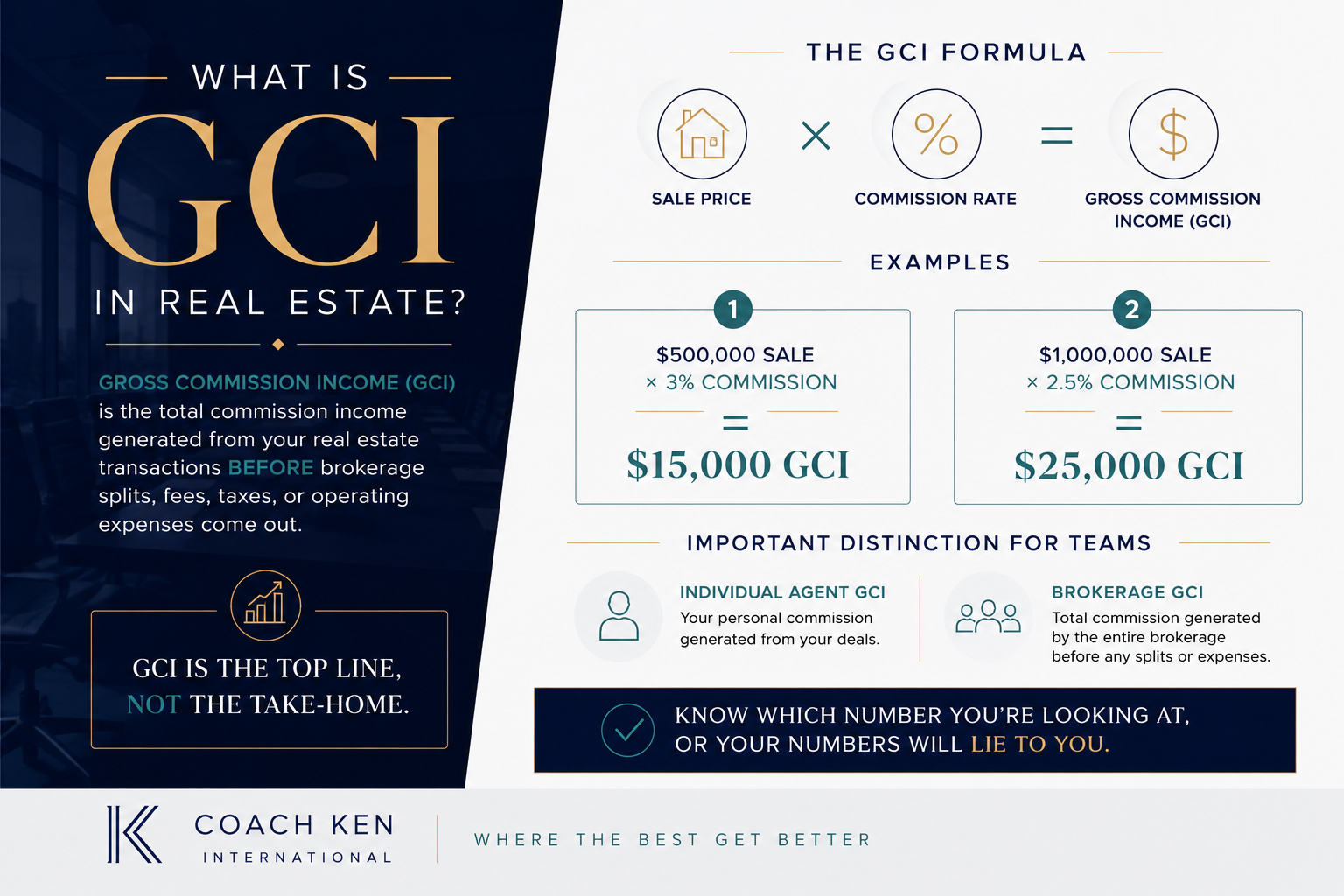
Gross Commission Income (GCI) is the total commission income generated from your real estate transactions before brokerage splits, fees, taxes, or operating expenses come out. It is the top line, not the take-home.
GCI is the commission revenue from your closed sales, purchases, and leases over a period, whether you measure it per deal, per month, or per year. When someone asks what is gci in real estate, this is the number they mean. It is what you generate, not what you keep.
The formula is simple. GCI equals sale price times commission rate.
- A $500,000 sale at a 3% commission produces $15,000 in GCI.
- A $1,000,000 sale at a 2.5% commission produces $25,000 in GCI.
One more distinction that matters for teams. A deal can be listing side, buyer side, or both sides, and there is a difference between an individual agent’s GCI and the brokerage’s GCI. When you run a team, you have to be clear about which one you are looking at, or your numbers will lie to you.

Why GCI Is the Wrong Finish Line (And the Right Starting Line)
GCI tells you how much commission you are generating. That is useful. But if you treat it as the finish line instead of the starting line, you can end up with impressive volume and disappointing profit.
Our industry over-celebrates GCI. Awards are handed out for volume. Social feeds are full of production screenshots. Almost nobody posts their net profit or how much time the owner actually has. Ken measures by GCI because it gives you the real numbers to plan from, but the target is profit. His benchmark is a 40 percent profit margin on revenue. A team doing $2M in revenue should be keeping around $800K, not $200K.
Picture two teams, both at $3M in GCI. Team A spends 80 percent on cost of sale and overhead and keeps $600K. The owner is busy and exhausted. Team B runs leaner, keeps a 40 percent margin and $1.2M, and the owner has systems and options. Same top line. The difference is the model, not the market.
So your job as a team leader is to read GCI as a leading indicator, then design the splits, staffing, and systems that turn it into a healthy margin. The headline number is where the work starts, not where it ends.
How to Calculate GCI for Your Team (Step-by-Step)
Calculating GCI is straightforward. Multiply each deal’s sale price by its commission rate, then add up the totals over the month, quarter, or year. Here is the clean process.
- Pull every closed transaction for the period from your MLS or CRM.
- For each deal, calculate GCI: sale price times commission rate.
- Separate listing-side and buyer-side GCI if you need that view.
- Sum the GCI by agent, by team, and by brokerage separately.
A quick rollup makes it real. Three closed deals at $15,000, $9,000, and $25,000 in GCI add up to $49,000 in team GCI for that stretch. Do that across the year and you have your annual number.
Watch the wrinkles. Commission rates often differ by price band or niche. Referral fees and co-brokerage splits reduce what you keep, even though the gross commission on the transaction stays the same. And GCI is most useful read next to sales volume and average deal size, which is exactly how Ken looks at them together during an assessment. Once you know what is gci in real estate and can calculate it fast, you can move to the numbers that really decide whether the business works.
GCI, Splits, Caps, and Expenses: Where the Money Actually Goes
GCI tells you the total commission earned. Your real income depends on how that GCI is split with the brokerage and the team, and what your operating expenses eat after that.
Three things move the money. Commission splits between the agent and the brokerage, like 70/30 or 80/20. Caps, which are the total a producer pays the brokerage before moving to a higher split or to 100 percent. And operating expenses: marketing, admin salaries, office, and technology.
Follow the ladder down. GCI is the top-line commission. After the broker split you have team GCI. After cost of sale, like agent splits and referral fees, you have gross profit. After operating expenses, you have net profit. As an example, a $5M GCI operation run at a 40 percent margin keeps about $2M, with the other $3M going to cost of sale and operating expenses. The leak is almost always hiding in one of those layers.
This is exactly why a Free Business Evaluation starts by mapping your GCI flow from the top line down to net. When you can see every layer, you can see where the money is actually going, and where it is quietly disappearing.
How Top Operators Use GCI (KPIs, Planning, and Scaling)
High-performing teams do not just track GCI. They use it as one of a handful of KPIs to set targets, design the org chart, and decide when and how to scale.
The smartest move is to plan backward. Decide the net income you want, apply a target margin, then calculate the GCI you actually need to hit it. From there, track GCI by agent, by lead source, by price band, and by neighborhood, so you can see where the profitable production really comes from. That same view tells you when to add a showing assistant, an ISA, or an operations leader, instead of hiring on a hunch.
In a session, Ken tends to ask the same hard questions. What is your current annual GCI? What is your true net margin after every expense? Which agents and lead sources produce the most profitable GCI, not just the most volume? And are you building toward a business someone would buy, or just chasing a bigger number?
That is why GCI plus a 40 percent margin is a far more powerful target than GCI alone. One measures how loud your business is. The other measures whether it is actually working.
Common GCI Traps for Teams and Brokerages (And How to Avoid Them)
The biggest GCI traps are celebrating volume without profit, ignoring cost of sale, and building a model that only works when the team leader is the top producer. Four show up again and again.
- Chasing high-price, low-margin deals that look great on a GCI report but barely move profit. Instead, judge production by margin, not just headline volume.
- Overpaying splits to recruit, which kills margin even as GCI climbs. Set splits on the reality of your numbers, not on what the shop down the street pays.
- Adding overhead too fast the moment GCI jumps, which erases the gain. Grow overhead slower than GCI, on purpose.
- Treating GCI as personal income instead of business revenue. Separate owner pay from profit, or you will never know if the business is actually healthy.
What Is GCI in Real Estate for Team Leaders vs Solo Agents vs Broker-Owners?
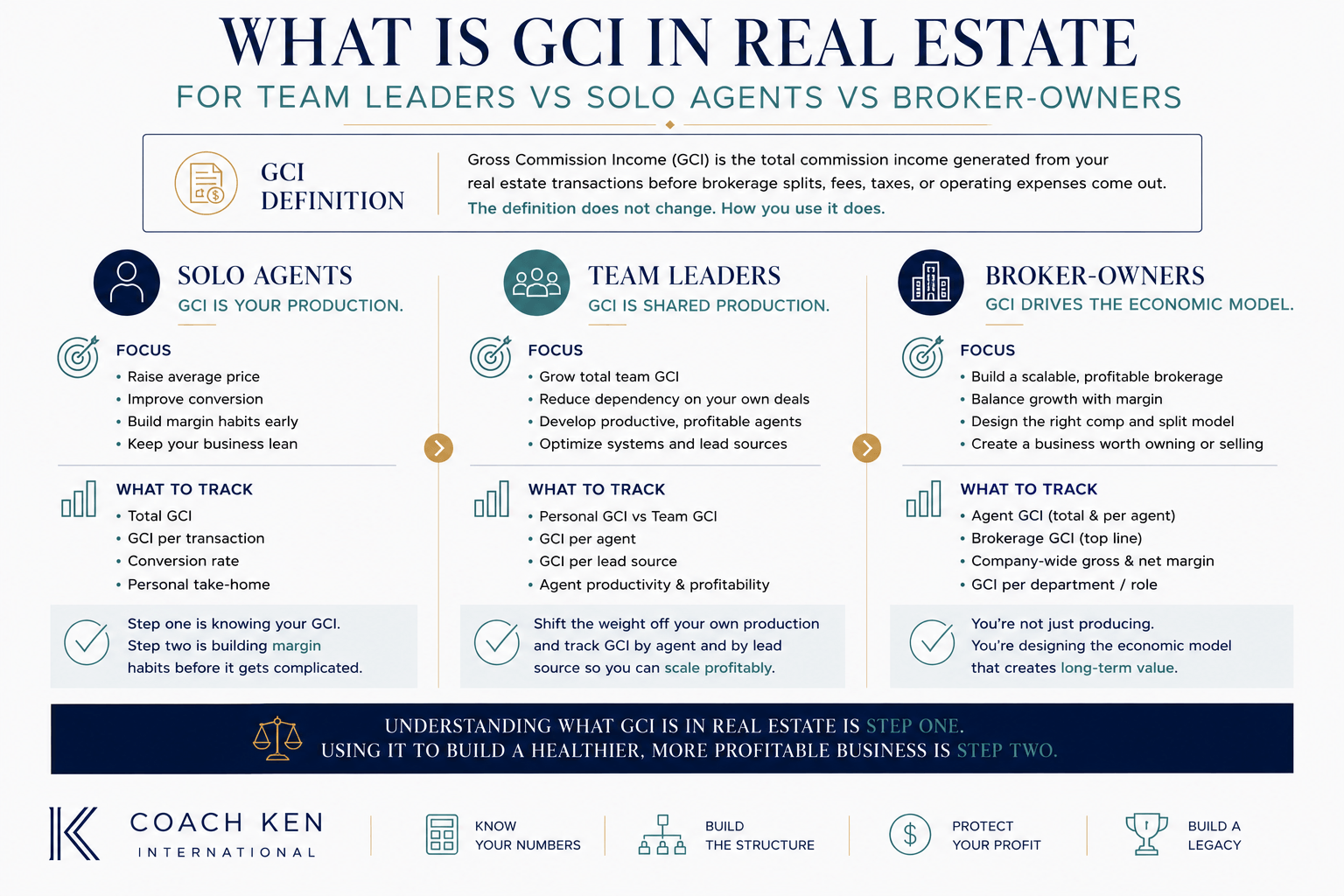
The definition of GCI does not change. How you use it does. The further you sit from the front line, the more you should be thinking about GCI per agent, per lead source, and per role.
For a solo agent, GCI is basically one line of production. The focus is raising average price, improving conversion, and building margin habits early, before the business gets complicated.
For a team leader, GCI splits into personal versus team production. The goal over time is to reduce how much of the total rides on your own deals, and to start tracking GCI per agent and per lead source so you can see who is really profitable.
For a broker-owner, you are watching agent GCI, brokerage GCI, and company-wide margin all at once. You are designing the economic model, not just your own book of business. For each of these roles, understanding what is gci in real estate is step one. Using it to build a healthier business is step two.
When to Talk to a Coach About Your GCI (and What Ken Looks For)
You know it is time for outside eyes when your volume looks good on paper but your profit, your time, or your team stress does not match the headline number. A few situations make a Free Business Evaluation worth it:
- Your GCI has grown, but your personal take-home has not.
- You are near or past $5M in GCI and still heavily in production as the leader.
- You are not sure how your splits, caps, and expenses compare to healthy benchmarks.
On that call, Ken’s team would review your last 12 months of GCI by agent and lead source, your P&L at a high level, including cost of sale, operating expenses, and profit, and whether your current model actually supports your long-term goals, whether that is to scale, to plan a succession, or to sell the business. The point is not a bigger GCI number. It is a business that pays you what the top line says it should.
Frequently Asked Questions
What is GCI in real estate?
GCI stands for Gross Commission Income. It is the total commission generated from your real estate transactions before splits, fees, or expenses. It is your top-line commission revenue, not your take-home pay.
How do you calculate GCI on a real estate deal?
Multiply the final sale price by the commission rate. A $500,000 sale at 3% is $15,000 in GCI. Add up every deal over the period to get your total.
Is higher GCI always better for a real estate team?
Only if profit and the owner’s time improve along with it. High GCI with a thin margin is one of the most common traps in the business. Volume is not the same as a healthy company.
What is the difference between GCI and net commission income?
GCI is the gross commission before any deductions. Net commission income is what is left after broker splits, fees, and often some expenses. The gap between the two is where the real story of your business lives.
How much GCI should a team leader aim for?
It depends on the net income you want and your target margin. Ken’s benchmark is a 40 percent profit margin on revenue, and at $5M GCI a team leader should be taking home at least $1.2M, not the $180K many settle for.
How can a Free Business Evaluation help with my GCI?
It gives you a neutral review of your GCI, your costs, and your profit, and shows whether your current model will actually get you to your goals. You leave knowing where the money goes and what to fix first.