

One-on-one coaching is not a weekly pep talk. It is a standing appointment where someone who has built and sold a real estate business takes apart your P&L, your org chart, and your lead systems to show you exactly what to fix first.
Most top producers hit a ceiling and quietly ask the same question: is real estate coaching worth it? They are doing real volume, but the profit, the time, and the team do not match the story. This page is for them, not for beginners.
If you are doing $500K or more in GCI, or running a $2M to $10M team, keep reading. I will show you exactly what 1-on-1 coaching looks like in real life, who it is right for, and when it is not worth your money. I would rather lose you here than waste your time and budget.
A quick note on who is saying this. I have coached top producers for more than 30 years, almost entirely the top 1 to 5 percent. Well over 1,000 teams. More than 600 broker‑owners. I have been involved in 50‑plus company sales and successions, and I built and sold my own 200‑agent brokerage plus two more teams.
If you would rather skip ahead and look at your own numbers, start with a free business evaluation. It is the same 35‑page diagnostic I run with private clients to find profit leaks, structure gaps, and succession risk. No sales pitch.
What Does a 1-on-1 Real Estate Coach Actually Do?
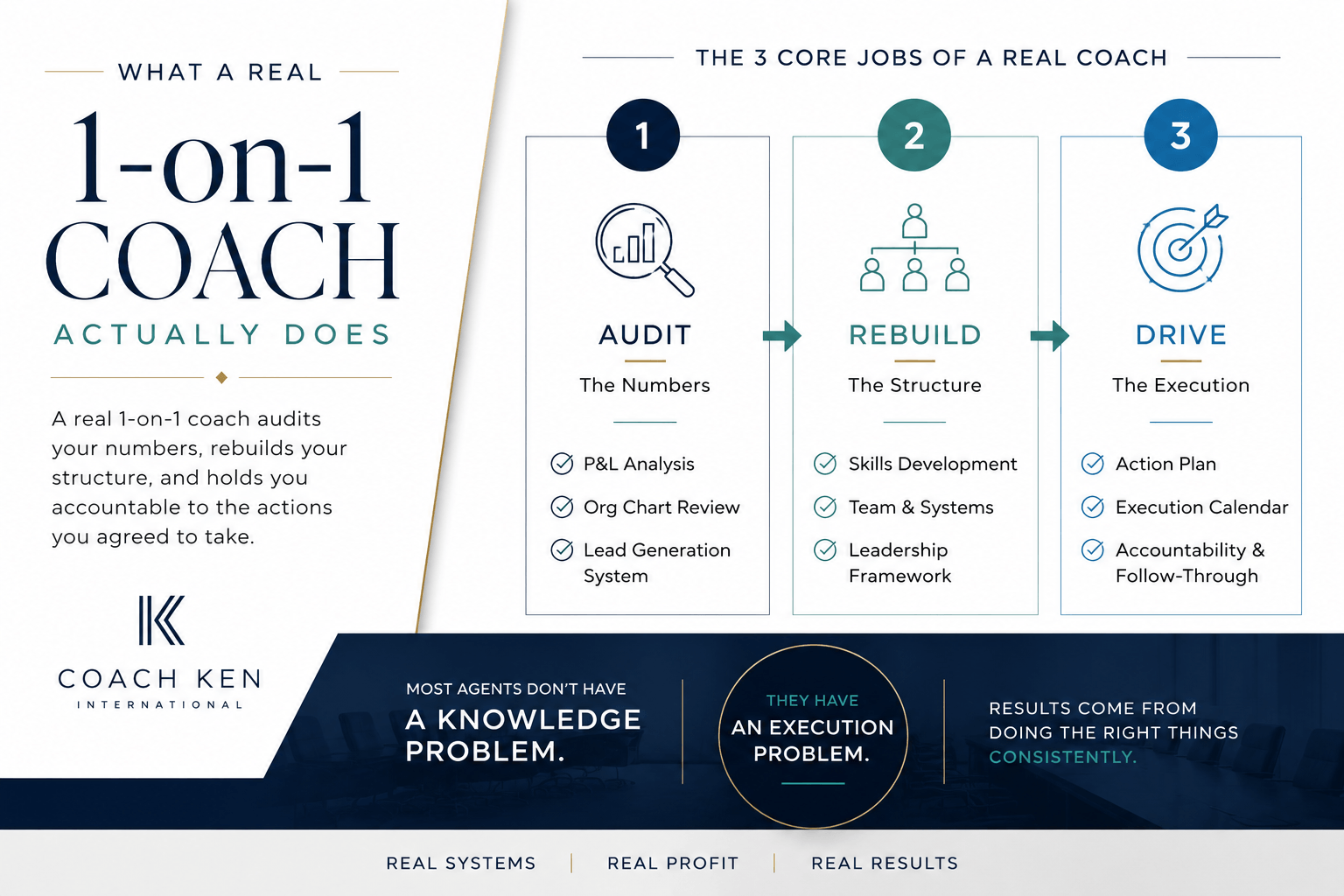
A real 1‑on‑1 coach does three things: they audit your numbers, they rebuild your structure, and they hold you to the actions you agreed to take. Everything else; the slogans, events, and hype; is window dressing.
Start with the work itself. When I take on a client, I look at three things: the P&L, the org chart, and the lead generation system. In that order. Everything else follows from there.
The first job is action over theory. You already know some of what you should be doing. My job is to turn that into a specific plan, a calendar, and a short list of non‑negotiables you actually execute. Most people do not have a knowledge problem. They have an execution problem and no one holding them to it.
The second job is skills. The real kind, not mindset fluff. How to win a high‑stakes luxury listing presentation. How to run a recruiting conversation that lands a producer. How to have the hard split conversation with an agent without losing them or your margin.
The third is the part most coaches skip: succession and luxury. Many of my best clients come in for one of those two and stay for full business coaching once they see how every decision. From who they hire to how they pay; feeds into it.

Is Real Estate Coaching Worth It?
For a $500K+ GCI agent or a $2M to $10M team leader, is real estate coaching worth it? Yes. If it closes a profit gap that is already costing you hundreds of thousands a year. For a beginner who wants motivation or scripts, usually not.
Look at two operators. One runs a $5M GCI team and takes home $180K. The structure is broken and the upside is enormous. The other is a $300K solo agent who has not yet built consistent lead generation. The first is leaving a fortune on the table. The second needs more reps, not high‑ticket coaching.
My benchmark is a 40 percent profit margin on revenue. A team doing $5M in GCI should take home at least $1.2M. Most take home far less. So the real question is not the monthly fee. It is the size of the profit leak you already have.
The data backs the direction, if not the precision. In an Inman survey of nearly 1,000 agents and brokers, more than 9 in 10 said their business grew at least 10 percent in their first year with a coach, and over half reported 25 percent or more growth. Useful context; but an average is not your business.
Here is what most online debates about is real estate coaching worth it get wrong. They argue about the monthly fee and ignore the profit delta. The operators who most need to ask is real estate coaching worth it are usually already losing more every month in leaked profit than a coach would charge.
What Does 1-on-1 Real Estate Coaching Look Like Week to Week?
A typical arrangement is a standing 30‑ to 60‑minute call each week or every other week, plus direct support between sessions. The value is not the call. It is the compounding effect of reviewing your numbers and your actions, over and over, with someone who has seen your exact pattern before.
Here is a 90-day view of how it usually runs.
Month One: Discovery and Diagnosis
It starts with the 35-page discovery process. I ask for your P&L, your org chart, production by agent, marketing spend, and a snapshot of your database. The first calls are about mapping the real problems: where profit leaks, where time gets trapped, where the team drags, and where succession risk is hiding.
Month Two: Structure and Systems
Now we rebuild. Roles and org chart first. Then splits, set against your profit target. Not whatever the team down the street pays. Then clear daily lead generation expectations for you and for every producer on the team.
Month Three: Accountability and Early Results
We review the P&L against the plan, monthly. Did the org changes happen? Did recruiting move? Did the marketing cuts hold? The early signs are usually cash flow improving, fewer fires, and more of your time freed up for actual CEO work.
This is not theory. One confirmed client went from $2M to $5M in revenue in the first three months of a year. Another went from $4M to $14M in GCI in two years. Both executed what we built. That is the part no coach can do for you.
Who Is 1-on-1 Real Estate Coaching Actually For?
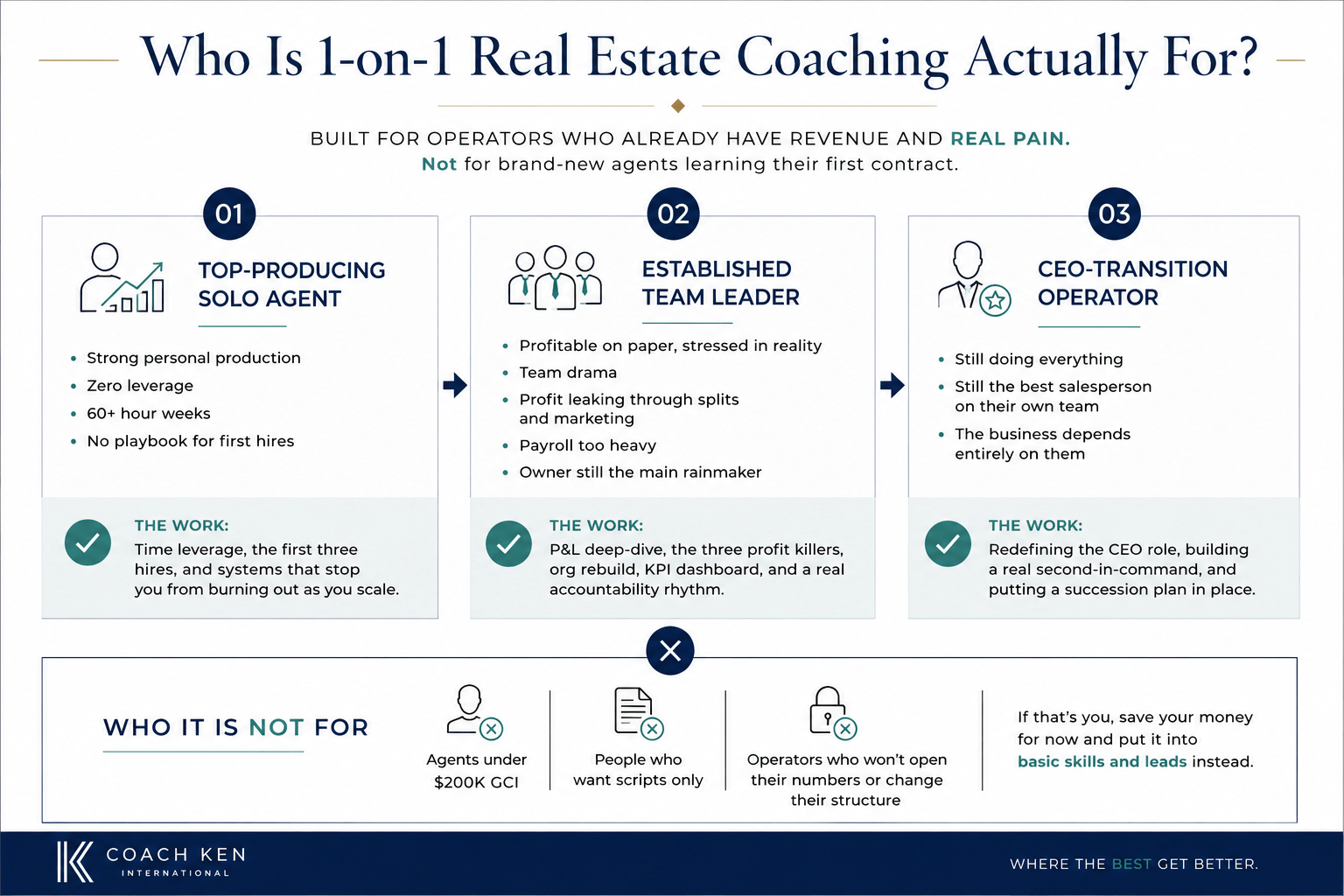
One‑on‑one coaching is built for operators who already have revenue and real pain: top producers at $500K+ GCI, team leaders running $2M to $10M, and broker‑owners with real overhead. It is not for a brand‑new agent learning to write a first contract.
Three profiles come up most often.
The top‑producing solo agent. Strong personal production, zero leverage, 60‑hour weeks, and no playbook for the first hires. The work here is time leverage, the first three hires, and systems that stop you from burning out as you scale.
The established team leader, profitable on paper and stressed in reality. Team drama, profit leaking through splits and marketing, payroll too heavy, and the owner still the main rainmaker. The work is a P&L deep-dive, the three profit killers, an org rebuild, a KPI dashboard, and a real accountability rhythm.
The CEO-transition operator. Still doing everything. Still the best salesperson on their own team. The business depends entirely on them. The work is redefining the CEO role, building a real second-in-command, and putting a succession plan in place.
Who it is not for: agents under $200K GCI, people who want scripts only, and operators who will not open their numbers or change their structure. If that is you, save your money for now and put it into basic skills and leads instead.
How Does 1-on-1 Coaching Compare to Group Coaching and Courses?
Group programs and online courses are efficient ways to hand information to thousands of agents. One‑on‑one coaching is inefficient on purpose. You are paying for a set of eyes on your specific business, not for more content.
Group coaching is cheaper per month and gives you community and some peer accountability. The trade-off is that the content has to stay general enough for beginners, nobody is reading your P&L, and no one is built around your constraints.
Online courses and free content are great for skills and ideas, and you can replay them forever. The catch is there is no feedback loop and no pressure to implement. It is easy to watch a lot and change nothing.
It is a bespoke plan, built by someone who knows your exact numbers, with sustained pressure to execute and the ability to adjust in real time when the market shifts. It costs more, and it only works if you are ready to change. The honest version of is real estate coaching worth it looks different once you compare it to the cost of staying in a generic program that never touches your structure.
What Results Can You Realistically Expect From 1-on-1 Coaching?
Most serious operators see clear structural change inside 90 days: cleaner numbers, better roles, fewer fires. Meaningful financial change usually shows up in 6 to 12 months; if they execute. Realistic does not mean easy. It means proportional to how willing you are to change your business.
My three confirmed client results show the range. A brother and sister who wanted out instead kept going, made more money, took more time off, and built a multi-million dollar operation. A California client went from $4M to $14M in GCI in two years. Another went from $2M to $5M in revenue in three months.
Coaching does not remove market cycles. It makes you less dependent on them. I started in this business when interest rates were 22 percent and still made money because I built on systems, not on conditions. That is the whole point.
And the wins are not only financial. The thing clients mention most is working fewer hours, feeling less on fire all the time, and finally owning a business someone else would actually want to buy.
How Much Does 1-on-1 Real Estate Coaching Cost, and How Should You Think About the Investment?
Group coaching usually runs from about $100 to $750 a month. Private one‑on‑one work commonly starts around $750 and climbs into the thousands per month, with elite programs higher. Those ranges come from current industry guides like HousingWire, The Close, and listing‑tool publishers, and from public tiers such as Tom Ferry, which lists roughly $749 to $2,999 a month. The only way to judge any of it is against your own profit leak and your timeline to fix it.
Premium private coaching is not a low-cost subscription for new agents. It is for operators already doing real revenue who want depth, not content. I will not quote a number here, because the right number depends entirely on what your discovery process turns up.
Use a simple model. If you are leaking $300K or more a year through broken splits, marketing overspend, and heavy payroll, a four‑figure monthly fee is a rounding error. If you do not know your numbers well enough to estimate that leak, coaching may have to start with basic financial clarity; and you still have to be willing to open the books.
So the only serious way to answer is real estate coaching worth it is to set the annual cost of coaching against the annual cost of your current profit gap. One of those two numbers is almost always much bigger.
How Do You Know if Now Is the Right Time to Hire a Real Estate Coach?
The right time is not when things feel calm. It is when the revenue looks good from the outside, but the profit, the time, and the team no longer match the story you are telling the market.
You are probably ready if:
- You are doing at least $500K GCI as an agent, or running a $2M to $10M team.
- You have at least one of these: a profit leak, team chaos, a time trap, or succession anxiety.
- You are willing to share your numbers, change comp, and make hard personnel calls over the next 12 months.
You are probably not ready if:
- You are still figuring out how to get consistent leads at all.
- You want motivation more than a spreadsheet.
- You are more excited about attending events than about changing how the business runs on Monday morning.
If you think you might be ready, the fastest way to find out is the free business evaluation. No pitch. You either fit, or you do not, and you will know quickly.
What Is the Next Step if You Are Serious About Fixing Your Business?
If you read this far, you are not asking the question in the abstract anymore. You are asking what it would take to fix your specific business in the next 12 to 24 months.
My job is simple to describe. I help top agents, team leaders, and broker‑owners run their businesses like CEOs instead of expensive employees by auditing the numbers, rebuilding the structure, and installing systems that work in any market.. That is different from big-brand motivational coaching in three ways: real operator experience, clear profit targets, and succession and luxury planning built in from day one. You can see how the 1-on-1 coaching works, or read my background, but the real test is your own numbers.
This is not for beginners, and it is not for people who want to keep things exactly as they are.
Start with a free business evaluation. It is the same 35‑page diagnostic I use with private clients to find profit leaks, structure gaps, and succession risk. No sales pitch. If the numbers say it is time to work together, we will both know.