
The coach you pick decides whether your team gets better or just busier. Most make teams busier. The right one fixes profit, structure, and leadership.
If you want to know how to choose a real estate team coach, start with their track record on real teams, not their marketing, and ask one question: will this coaching simplify my business, or add more noise? Most coaches add noise. They hand you scripts and hype, and your team gets busier without getting better.
You know the scenario. A $5M GCI team leader. Calendar full, profit thin. Already been through one or two big-box programs that changed very little. The activity went up. The take-home did not.
Here is my stance. Team coaching is a profit, structure, and leadership job, not a motivation job. If a coach cannot talk P&L, org chart, and splits, they are not a team coach. They are a speaker.
I have spent more than 30 years on this, with over 1,000 teams and 600 broker-owners coached. Read this first, then if you want to go deeper on systems, Scaling Your Real Estate Business is the guide built from the same frameworks I use with top teams.


What Is Real Estate Team Coaching Actually Supposed to Fix?
Done properly, real estate team coaching fixes profit, structure, and leadership, so the business runs without you being both the top producer and the emergency contact for every problem.
It is not the same as one-on-one agent coaching or generic productivity coaching. Agent coaching works on scripts, habits, and mindset. Team coaching works on the P&L, the org chart, the splits, and the succession plan. One builds a better salesperson. The other builds a better business.
So a real team coach should be comfortable talking about a short, specific list of things:
- Profit margin, with a real target. Mine is 40 percent on revenue.
- GCI versus revenue, and the KPIs that actually run the business.
- The team org chart and clear roles, not just headcount.
- Culture and the retention of your best agents.
Why Most Real Estate Coaches Quietly Add to the Mess (And 5 Red Flags to Spot Them)
Most coaches add to the mess because they sell volume-driven, one-size-fits-all programs that ignore your numbers, your capacity, and your structure. You get more activity and the same profit problem. Here are five red flags.
- They have never run a team or brokerage at your scale. Their name is built on content, not on a P&L they were personally responsible for.
- The whole program is more leads and more agents. It never mentions profit margin, take-home, or when you get to step out of production.
- You never see real before-and-after numbers for the teams they have coached. Just testimonials about how good the energy was.
- You sign up for a name and get handed a junior coach you have never heard of, with none of the track record you were sold on.
- The contract controls your data or your systems, or limits what you can use after you leave. Read that language before you sign anything.
My position is the opposite of a mass-market bootcamp. I do not sell rah-rah. I start with the structural problems: the P&L, the org chart, the splits, and the succession path. That is the work that actually changes a team.
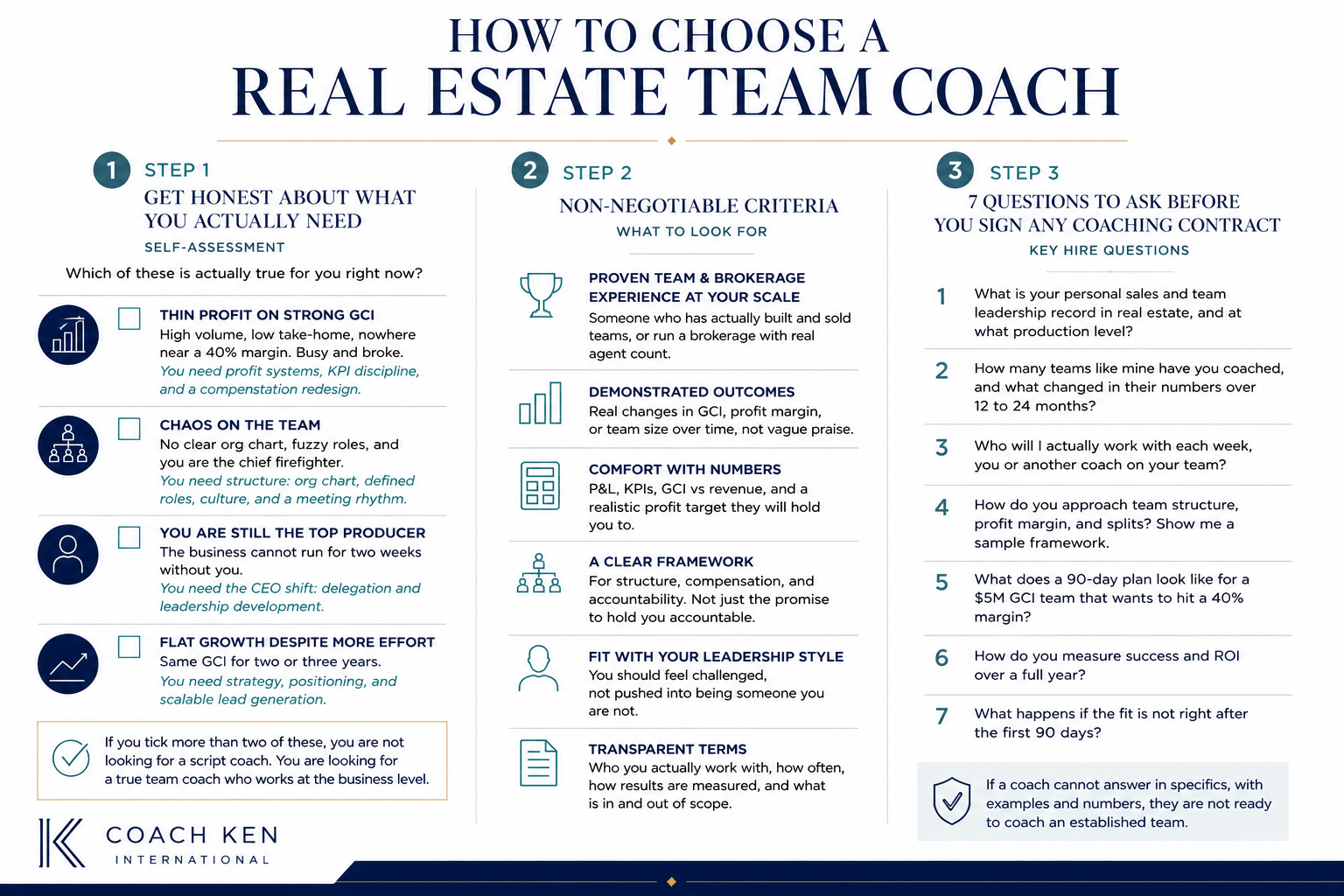
Step 1: Get Honest About What You Actually Need from a Team Coach (Self-Assessment)
Before you ask how to choose a real estate team coach, get clear on your real constraint: profit, structure, leadership, or lead flow. The right coach matches that constraint instead of selling you everything at once.
Run an honest self-diagnostic. Which of these is actually true for you right now?
- Thin profit on strong GCI. High volume, low take-home, nowhere near a 40 percent margin. Busy and broke. You need profit systems, KPI discipline, and a compensation redesign.
- Chaos on the team. No clear org chart, fuzzy roles, and you are the chief firefighter. You need structure: an org chart, defined roles, culture, and a meeting rhythm.
- You are still the top producer. The business cannot run for two weeks without you. You need the CEO shift: delegation and leadership development.
- Flat growth despite more effort. Same GCI for two or three years. You need strategy, positioning, and scalable lead generation, not just more hustle.
If you tick more than two of those, you are not looking for a script coach. You are looking for a true team coach who works at the business level.
Step 2: Non-Negotiable Criteria for Any Real Estate Team Coach
Any serious answer to how to choose a real estate team coach starts with non-negotiable criteria: real team-building experience, hard numbers, a clear method, and client outcomes you can verify.
How to Choose a Real Estate Team Coach: The Non-Negotiables
- Proven team and brokerage experience at or above your size. Someone who has actually built and sold teams, or run a brokerage with real agent count.
- Demonstrated outcomes. Real changes in GCI, profit margin, or team size over time, not vague praise.
- Comfort with numbers. P&L, KPIs, GCI versus revenue, and a realistic profit target they will hold you to.
- A clear framework for structure, compensation, and accountability. Not just the promise to hold you accountable.
- Fit with your leadership style. You should feel challenged, not pushed into being someone you are not.
- Transparent terms. Who you actually work with, how often, how results are measured, and what is in and out of scope.
Step 3: The 7 Questions to Ask Before You Sign Any Team Coaching Contract
Treat the coach like a key hire. Ask specific questions about their sales history, team-building experience, coaching outcomes, and how they will work with you week to week. Here are the seven I would ask.
- What is your personal sales and team leadership record in real estate, and at what production level?
- How many teams like mine have you coached, and what changed in their numbers over 12 to 24 months?
- Who will I actually work with each week, you or another coach on your team?
- How do you approach team structure, profit margin, and splits? Show me a sample framework.
- What does a 90-day plan look like for a $5M GCI team that wants to hit a 40 percent margin?
- How do you measure success and ROI over a full year?
- What happens if the fit is not right after the first 90 days?
If a coach cannot answer in specifics, with examples and numbers, they are not ready to coach an established team.

What Real Team Coaching with a Structural Focus Looks Like (Ken’s Approach)
High-level team coaching should feel like working with a partner who has built and sold companies, not a cheerleader. The sessions are about numbers, people, and systems you can measure. Not inspirational quotes.
My focus areas for team leaders are simple and in order. Profit first: the 40 percent margin benchmark, tightening expenses, right-sizing support, and resetting splits using your real numbers. Then team structure: an org-chart-first approach that frees up the leader’s time and makes roles clear.
Then leadership: the shift from top producer to CEO, so the business stops routing every decision back through you. And finally the long game: building a team that can run, and one day sell, instead of one that just spins faster.
I do not invent results to sell this. The clients who have done it executed the plan we built together. That is the difference from a mass-market group call full of scripts and energy. One reads your numbers. The other reads from a slide.
How to Compare Real Estate Team Coaches Side-by-Side (Simple Scorecard)
To decide clearly, score each coach on the same factors, then weigh that against the investment and your timeline. Rate each one from 1 to 5 on the points below, and weight experience and outcomes far more heavily than price.
- Have they run a team or brokerage at my scale?
- How many teams have they actually coached?
- Do they have a clear framework for org structure and profit?
- Can they show documented before-and-after results?
- Do I get direct access to the lead coach, or a junior?
- Is there a real cultural and communication fit?
Add up the scores, but do not let price decide it. The cheapest coach who cannot read a P&L is the most expensive choice you will make.
When a Team Coach Is the Wrong Move (And What to Do Instead)
Do not hire a team coach if you are still a solo agent, still figuring out basic lead generation, or if your real problem is one bad hire rather than your structure. In those cases, you need training or a narrower engagement, not full team coaching.
If you are earlier in the journey, start with a strong training program or one-on-one coaching to build your own production first. And if your business is solid but you want a short, focused outside look before committing to anything long-term, an in-office assessment is the right size of step.
How Ken Works with Established Teams
For an established team leader, my coaching starts with a detailed look at your numbers, structure, and goals, then builds a focused plan to grow profit and free your time. Not just to grow volume.
It starts with discovery. A business evaluation and the 35-page discovery process, then a deep dive into the P&L, the org chart, the splits, and the KPIs that matter. From there, a 90-day plan built on one to three structural fixes, like a comp plan, a meeting rhythm, and leadership delegation, instead of twenty initiatives nobody finishes. Then a steady cadence with real accountability.
If you want to map your own org chart, profit targets, and scaling plan before we ever talk, start with Scaling Your Real Estate Business. It is built from the same frameworks I use with the top teams I coach: vision, core customer, KPIs, and milestones.
Frequently Asked Questions
What is real estate team coaching?
Real estate team coaching is coaching focused on the business behind the team: profit, org structure, compensation, leadership, and succession. It is different from agent coaching, which works on individual production. The goal is a team that runs on systems, not on the leader doing everything.
How to choose a real estate team coach?
Look for four things: a real track record building or selling teams at your scale, a structural focus on profit and org design, proof of results you can verify, and a genuine culture fit. Use the scorecard above before you sign any contract. The right coach matches your actual constraint instead of selling you everything at once.
How is a real estate team coach different from a general real estate coach?
A team coach works on the structure, compensation, and leadership of multiple producers. A general coach usually focuses on one agent’s habits and lead generation. If your problem is profit and structure across a team, a general coach is the wrong tool.
What is a good profit margin for a real estate team?
My benchmark is a 40 percent profit margin on revenue. A team doing $5M in GCI should be taking home at least $1.2M. High volume with thin margin is a trap, because you are working harder every year to keep the same amount.
How long does it take to see results from real estate team coaching?
Changes to splits and structure can move your margins within the first 90 days. The deeper wins, leadership depth and a business that runs without you, usually take 12 to 18 months of consistent work. Speed depends on how willing you are to change the structure, not just the activity.
Can AI replace a real estate team coach?
No. AI is a useful tool for tracking, reminders, and drafting, but it cannot replace decades of pattern recognition on people, structure, and succession. Experience is what makes the tool work, not the other way around.